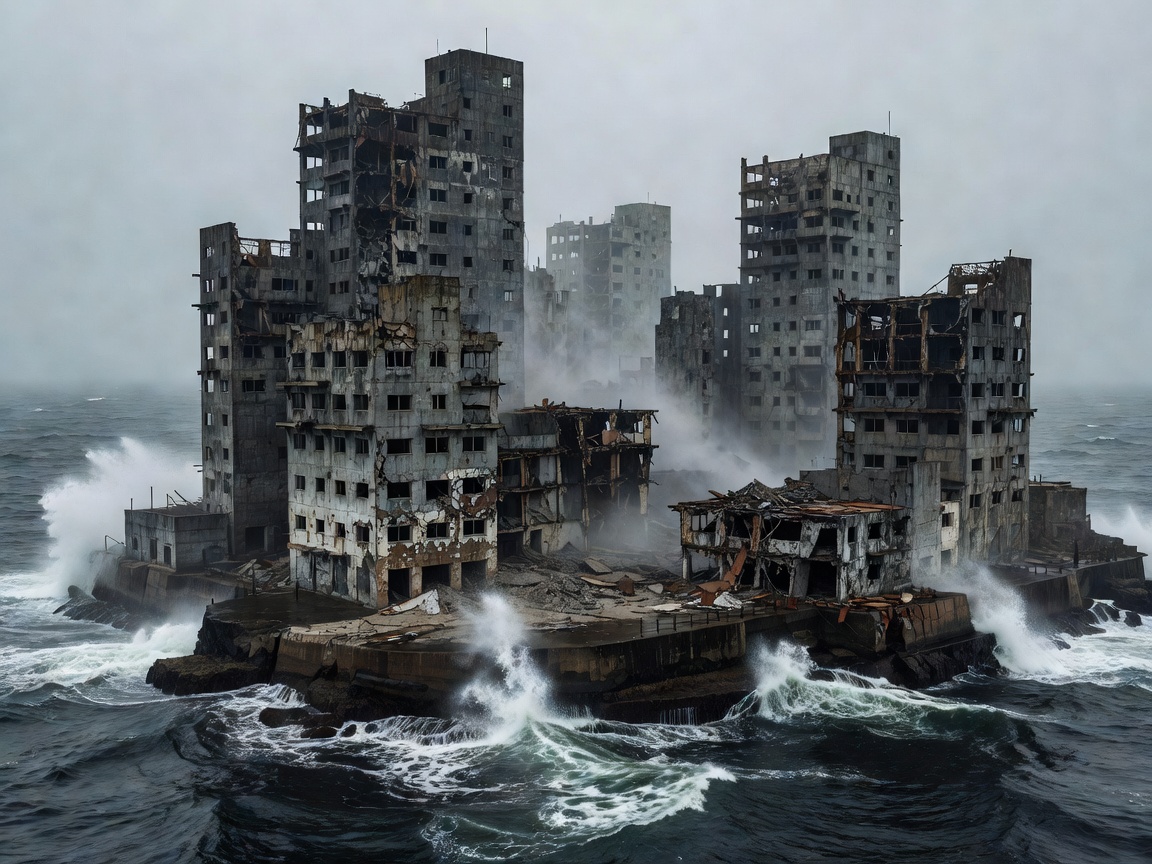
Subsea Excavation and Vertical Densification
Situated 15 kilometers off the coast of Nagasaki, Hashima was little more than a barren reef until undersea coal seams of extraordinary caloric purity were discovered in 1887. Mitsubishi purchased the rock in 1890 and began a multi-decade land reclamation campaign, ringing the perimeter with towering stone and concrete sea walls designed to withstand savage Pacific typhoons.
To accommodate the ever-expanding workforce, Mitsubishi built vertically. In 1916, they completed Building 30: a pioneering 7-story reinforced concrete residential apartment. Over subsequent decades, the entire 16-acre footprint was built over with multi-story apartment complexes, rooftop vegetable gardens, schools, a hospital, twenty-five shops, a cinema, and communal bathhouses. By 1959, Hashima boasted a population density of 835 people per hectare—more than nine times that of contemporary Tokyo.
The Sudden Evacuation of April 1974
During the 1960s, the global energy matrix shifted permanently from coal to petroleum. Mines across Japan shuttered, and in January 1974, Mitsubishi officially announced the closure of the Hashima colliery.
The departure of the populace was swift and total. Because the island had to be vacated within a few brief months, families left heavy furniture, television sets, sewing machines, and school textbooks in situ. By April 20, 1974, the last resident boarded the ferry, and Hashima was sealed to the elements. For thirty-five years, it was illegal to set foot on the island.
Hashima Island Operational Statistics
- Geographic Footprint: 480 meters long by 160 meters wide (6.3 hectares).
- Peak Population: 5,259 residents recorded in 1959.
- Subsea Depth: Shafts penetrated over 1,010 meters beneath sea level.
- Total Coal Extracted: Approximately 15.7 million metric tons over 84 years.
- Heritage Classification: Inscribed as a UNESCO World Heritage site in 2015.
The Relentless Pacific Attrition
Without human heating, ventilation, and maintenance, ocean salt spray began infiltrating the reinforced concrete. The iron rebar oxidized, expanded, and spalled the concrete facades off whole buildings. Typhoons repeatedly battered the northern seawalls, peeling away outer corridors.
Today, Hashima serves as humanity's starkest laboratory on the lifespan of concrete. It demonstrates unequivocally how rapid industrial progress constructs and discards entire civilization pods when economic incentives vanish.
Explore the official UNESCO listing of Sites of Japan's Meiji Industrial Revolution.